Anthropic FlashProve 2026: Verifiable AI Model Inference for Users and Developers
Anthropic FlashProve uses zkSNARKs to let anyone verify that model outputs match committed weights without exposing the model itself.
Anthropic FlashProve, released on November 2 2026, provides an open-source method for proving that a specific set of model weights produced a given output. The system relies on zkSNARKs to create a short commitment to the weights and attach a cryptographic proof to each response. Users can verify the proof on ordinary CPUs without access to the weights or a GPU.
This approach addresses situations where API providers might substitute a cheaper model or where servers could be tampered with. The prototype supports Llama 4 Maverick in 4-bit quantized form and limits contexts to 1,024 tokens under greedy decoding.
How Anthropic FlashProve Generates and Verifies Proofs
The process divides into two phases. First, the model provider creates a one-time commitment file that binds the exact weights while keeping them private. This file measures about 6.5 MB and supports roughly 16 million requests before a new commitment is needed. Generation takes approximately 39 minutes on the tested hardware.
In the online phase, the prover produces a zkSNARK proof for each prompt and output pair. The proof confirms that the committed model generated the exact token sequence. Proof generation occurs on an NVIDIA H100 GPU and takes about 223 seconds for a batch of 24 requests of 1,024 tokens each. The resulting proof file is roughly 18.78 to 19 MB.
Verification runs on standard CPU hardware. A machine with 24 threads completes verification in about 17 seconds, while a single thread needs around 21 seconds. No GPU or model weights are required on the verifier side. The protocol also includes a slower but formally verified Lean implementation that checks the same soundness, completeness, and zero-knowledge properties.
Benchmarks and Resource Overhead Compared to Standard Inference
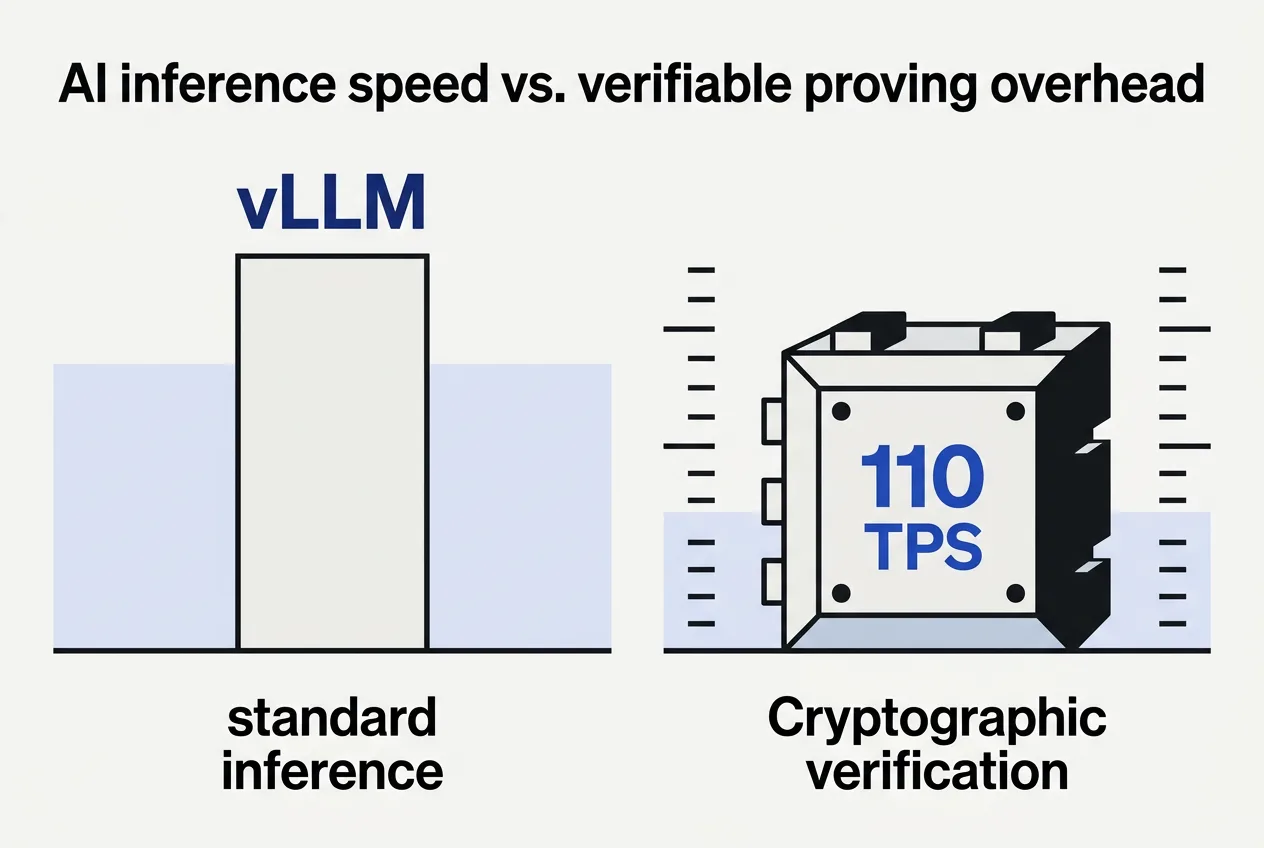
Tests on Meta’s Llama 4 Maverick show clear performance trade-offs. Proving speed reaches about 110 tokens per second on one H100 GPU. This rate is 70 to 95 times slower than standard vLLM inference for identical requests, reflecting the added cryptographic work.
| Metric | FlashProve | Standard vLLM |
|---|---|---|
| Proving / inference time (batch of 24 × 1,024 tokens) | 223 seconds | ~2.3–3.2 seconds |
| Proof size per request | 18.78–19 MB | Not applicable |
| Verification time (24 CPU threads) | 17 seconds | Not applicable |
| Commitment generation | 39 minutes | Not applicable |
The overhead makes the current implementation unsuitable for high-volume production APIs. However, the design allows independent verification of model provenance, which standard inference systems cannot provide. The Apache 2.0 release on GitHub includes the prover, a fast C++ verifier, the Lean verifier, and the protocol specification. No model weights are bundled; users obtain Llama 4 Maverick separately from Hugging Face.
Practical Use Cases and Limitations for Developers
FlashProve targets scenarios that require proof of model identity rather than raw speed. Regulators or auditors can request proofs to confirm that a deployed system used the declared weights. Organizations can publish commitments to give customers verifiable integrity guarantees for outputs. Third-party evaluators can check provenance claims without trusting the inference provider’s infrastructure.
Developers integrating the tool should note several constraints. The system only proves exact outputs under greedy decoding within 1,024-token contexts. It does not hide model architecture and treats the model as an integer program. The release is described as an unmaintained research artifact with no production deployment plans from Anthropic or partner labs.
Future improvements could reduce proof size and generation time through community work on the open prototype. Adoption would require labs to publish commitments publicly and integrate the prover into serving stacks. Until then, the main value lies in controlled testing environments where model provenance matters more than latency.
Frequently asked questions
What models does Anthropic FlashProve currently support?
The prototype has been tested on Meta’s Llama 4 Maverick in 4-bit quantized form. Other models require compatible integer representations and 1,024-token context limits.
How long does it take to verify a single proof?
Verification completes in roughly 17 seconds on 24 CPU threads or 21 seconds on a single thread. No GPU or model weights are needed.
Can FlashProve be used in production APIs today?
The release is labeled an unmaintained research artifact. Proving overhead of 70–95× standard inference time makes immediate high-volume use impractical.
Where can developers access the code and documentation?
The full package is available under Apache 2.0 on GitHub at anthropics/FlashProve. It includes the prover, verifiers, protocol spec, and Lean security proofs.
Comments 6