Best Encrypted File Sharing 2026: E2EE Providers Compared
Providers with true client-side E2EE keep files, names and metadata private from the service itself. Several established options meet this standard in 2026.
Best encrypted file sharing 2026 centers on services that apply zero-knowledge encryption before data leaves the device. This approach prevents the provider from reading file contents or metadata. Users who need privacy beyond standard TLS and server-side encryption now have several audited choices.
Providers With Default Zero-Knowledge E2EE
Proton Drive applies end-to-end encryption to every file, folder name and metadata by default. The service is based in Switzerland, offers open-source clients and holds ISO 27001 and SOC 2 certifications. Free accounts receive 5 GB; paid plans start at roughly 200 GB for $4.99 per month or lower with annual billing.
Tresorit, also Swiss, uses AES-256 and RSA-4096 for enterprise-grade zero-knowledge protection. It supplies granular permissions, audit logs and watermarks. The platform meets GDPR, HIPAA, SOC 2 and ISO 27001 standards and targets regulated industries.
Sync.com in Canada encrypts files by default and supports versioning up to 365 days on higher tiers. It complies with HIPAA and GDPR. Free storage is 5 GB; paid plans offer 2 TB from $8–$12 monthly with annual discounts.
MEGA provides 20 GB free and uses AES-128 with RSA-2048 for zero-knowledge encryption. Paid tiers reach several terabytes for under $12 monthly. Transfer quotas apply on all accounts.
Feature and Pricing Comparison
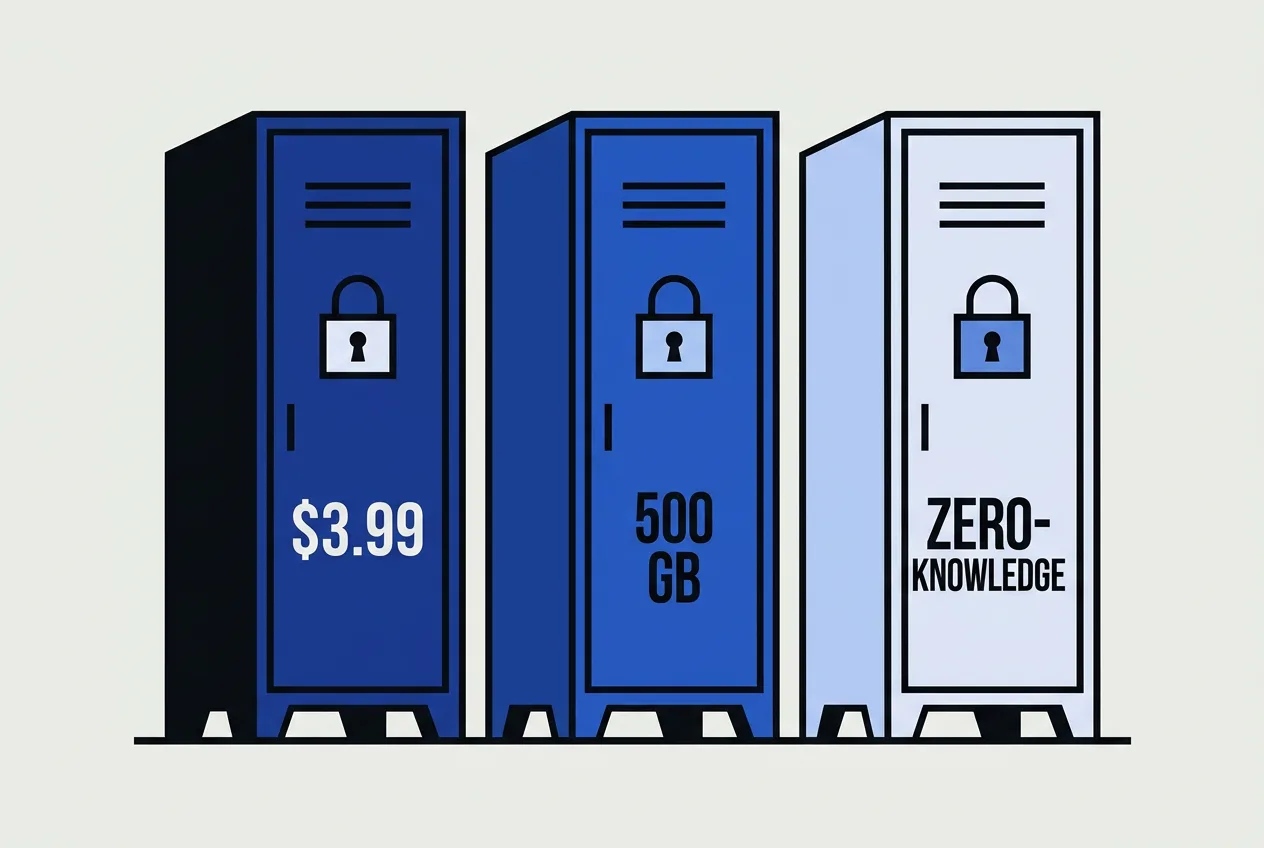
Additional providers such as NordLocker, Internxt and Filen deliver optional or default E2EE at lower per-gigabyte rates. NordLocker focuses on encrypted lockers priced near $3.99 monthly for 500 GB. Self-hosted Nextcloud remains an option for users who prefer full control.
Services without default zero-knowledge encryption, including standard Dropbox and Google Drive, allow the provider to access plaintext. Post-2024 studies from ETH Zurich showed that implementation quality matters; audited providers performed more reliably.
| Service | Free Storage | Paid Starting Price | Key Strengths | Compliance |
|---|---|---|---|---|
| Proton Drive | 5 GB | $4.99/mo (200 GB) | Open-source clients, ecosystem bundles | ISO 27001, SOC 2 |
| Tresorit | 3 GB | $11.99/mo (1 TB) | Granular controls, audit logs | GDPR, HIPAA, SOC 2, ISO 27001 |
| Sync.com | 5 GB | $8/mo (2 TB) | Long versioning, HIPAA support | GDPR, HIPAA |
| MEGA | 20 GB | $9.78/mo (2–3 TB) | Largest free tier, extras on paid | Basic data protection |
Selecting a Service
Teams handling regulated data often choose Tresorit for its compliance tooling and audit features. Individuals already using Proton services gain convenience from its integrated privacy suite. Users seeking maximum free storage or generous transfer allowances may prefer MEGA despite quota limits.
Check current annual promotions, because pricing changes frequently. Verify that the chosen plan includes client-side encryption rather than optional paid folders. Self-hosting with Nextcloud suits organizations that require complete administrative control over keys and servers.
Frequently asked questions
Which services offer true zero-knowledge encryption by default?
Proton Drive, Tresorit, Sync.com and MEGA encrypt files client-side before upload. The provider cannot access plaintext or metadata under normal operation.
How do pricing plans differ among these providers?
Free tiers range from 3 GB to 20 GB. Paid plans start near $4.99 monthly for smaller storage and rise to $12–$27 monthly for multi-terabyte options with annual billing discounts.
What compliance standards matter for business use?
HIPAA, GDPR, SOC 2 and ISO 27001 appear on Tresorit, Sync.com and Proton Drive. These certifications help organizations meet regulatory requirements for data handling.
Are there risks with E2EE implementations?
Audited code and independent reviews reduce risks. Services without recent audits may contain implementation flaws that weaken encryption guarantees.
Comments 2