Domain Registrar Data Breach Response Protocols 2026: ICANN Reporting and Audits
Domain registrars face specific obligations during data breaches. ICANN requires notification within seven days, while user alerts follow national privacy laws.

Domain registrars must report security breaches involving registrant data to ICANN within seven days under the Registrar Accreditation Agreement. This timeline covers incidents affecting account information or registration data, with details on timing, access type, cause, affected numbers and actions taken. Failure to meet these standards triggers compliance reviews and possible sanctions.
ICANN Breach Reporting Requirements for Domain Registrars
Registrars submit breach notices by email to compliance@icann.org with the subject line “Registrar Bankruptcy, Conviction or Security Breach.” The template requires the incident date and time, description of unauthorized access, root cause, count of affected registrants and domains, plus mitigation steps. Quarterly ICANN summaries show most periods with zero reports, though one cluster in April–June 2025 covered three registrars and roughly 689,000 registrants plus 1.27 million domains.
Registrars also maintain DNS abuse contacts under the April 2024 RAA amendment and investigate credible reports of malware, phishing or botnets within set windows. ICANN escalates repeated failures to termination, as seen with Trustname.com and IPIP Inc. in August 2026. Targeted audits in 2025 focused on high-abuse registrars produced over 650 investigations, more than 570 resolutions and 70 completed remediation plans with low recurrence.
Practical response includes immediate isolation of affected systems, preservation of logs for at least two years and preparation of the standardized ICANN template. Registrars that skip early contact risk additional breach notices and loss of accreditation.
User Notifications and Security Audit Practices
Registrant notifications follow applicable national or state privacy statutes rather than a single ICANN rule. Many jurisdictions require disclosure without unreasonable delay, with specific windows of 30 to 60 days in certain U.S. states. Registrars must also publish and follow their own abuse-handling procedures while keeping records for audits.
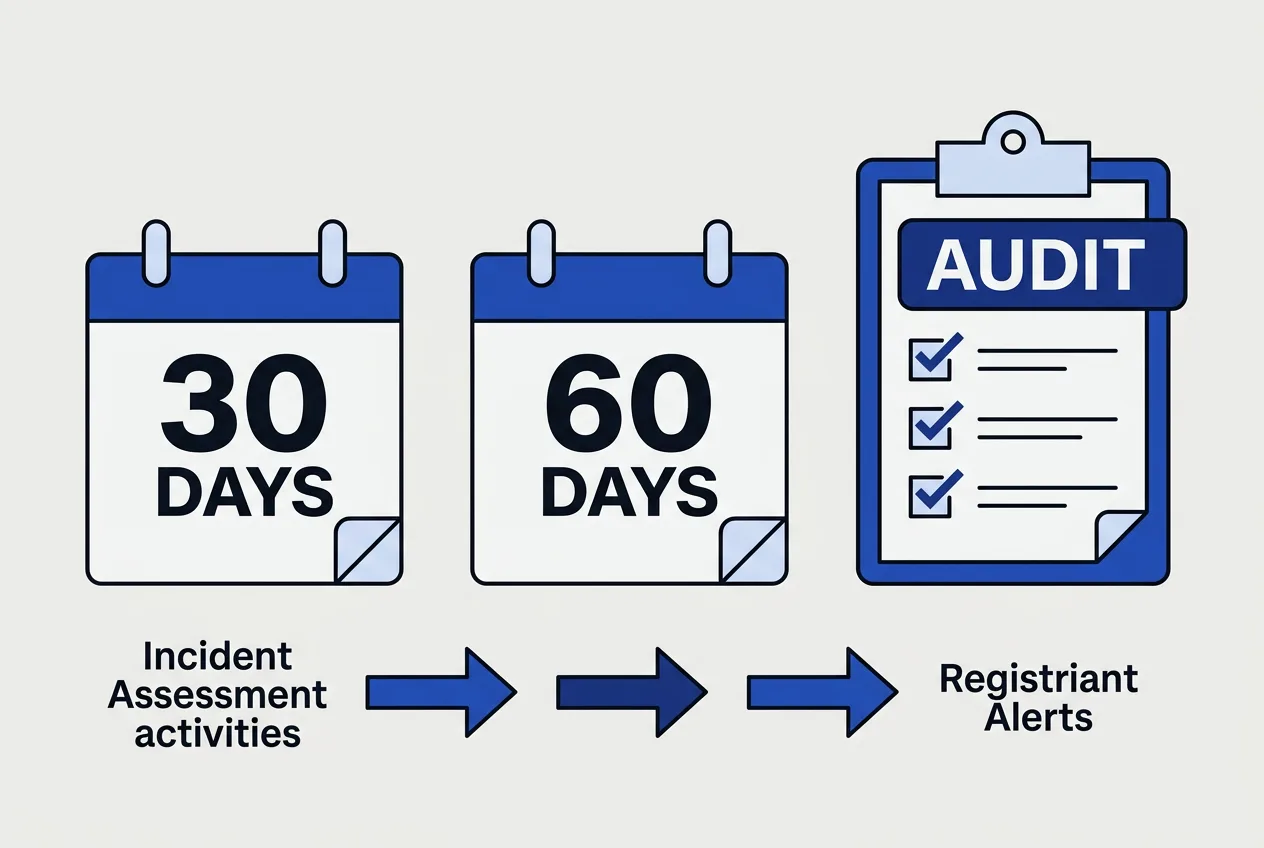
Security audits examine account controls such as two-factor authentication, transfer locks and monitoring for anomalous access. ICANN’s Contractual Compliance tracks remediation plans and publishes aggregated statistics. An ongoing GNSO PDP considers “associated domain checks” after abuse evidence, noting that 56.4 percent of sampled malicious gTLDs showed at least one linked registration under the same account.
| Requirement | ICANN Timeline | Typical Privacy Law Timeline | Record Retention |
|---|---|---|---|
| Initial breach notice | 7 days | Without unreasonable delay | 2 years minimum |
| DNS abuse investigation | Prompt after credible report | N/A | 2 years |
| Remediation plan submission | As requested by Compliance | Varies by jurisdiction | Duration of plan |
Law-enforcement requests for non-public data now route through testing of SAML authentication in the Registration Data Request Service. Authenticated urgent cases receive a 24-hour response window, extendable to 72 hours for complex matters. Registrars retain denial rights when requests fall outside defined criteria such as imminent threat to life or child exploitation.
Common preparation steps include mapping all systems holding registration data, testing incident playbooks quarterly and documenting every access attempt. These measures reduce both regulatory exposure and the time needed to compile ICANN submissions.
Frequently asked questions
How quickly must a registrar notify ICANN of a data breach?
ICANN requires notification within seven days of discovering a breach involving registrant account or registration data. The report uses a fixed template sent to compliance@icann.org.
Do registrars have to notify affected domain owners directly?
Direct user notification follows national or state privacy laws, which often set windows of 30 to 60 days or require action without unreasonable delay. ICANN itself does not set a uniform registrant-notification deadline.
What happens if a registrar fails repeated DNS abuse checks?
ICANN issues breach notices and may terminate accreditation. Two registrars lost accreditation in August 2026 after multiple failures to mitigate malware and phishing reports.
Are security audits mandatory for all registrars?
Targeted audits focus on high-abuse registrars, but every accredited registrar must maintain records and remediation plans for at least two years. ICANN Compliance monitors outcomes across the industry.
Comments 15