Genie 4 Google DeepMind Adds Native Audio and Real-Time Steering to Interactive Simulations
Genie 4 Google DeepMind generates photorealistic navigable simulations from text or images with synchronized audio and natural language control.
Genie 4 Google DeepMind generates photorealistic, navigable environments from text prompts or reference images and now includes native audio. Announced on October 27, 2026, the model produces ambient sounds, music, and adaptive dialogue that match on-screen actions without separate post-processing steps.
Users steer scenes through natural language commands that adjust weather, camera angles, or introduce objects while the simulation continues. Gemini Omni anchors character appearance and behavior, while Gemini 3.8 Flash plans multi-step events and maintains frame-to-frame coherence.
Core Features of Genie 4 Google DeepMind
The model renders scenes frame by frame rather than as fixed video clips, allowing continuous keyboard navigation or text-based adjustments. Audio generation occurs simultaneously with visuals, creating synchronized soundscapes that respond to user inputs such as opening doors or changing environments.
Typical sessions last up to a few minutes of uninterrupted interaction, an improvement over earlier limits. Physics handling covers aerodynamics and collisions, while character movements appear more natural than in prior versions. All outputs carry SynthID watermarks for traceability.
Practical applications include robot training in controlled settings, prototyping game levels, and creating interactive learning modules. Filmmakers and journalists have tested the tool for rapid scene visualization with audio cues already embedded.
Comparison with Genie 3 and Access Details
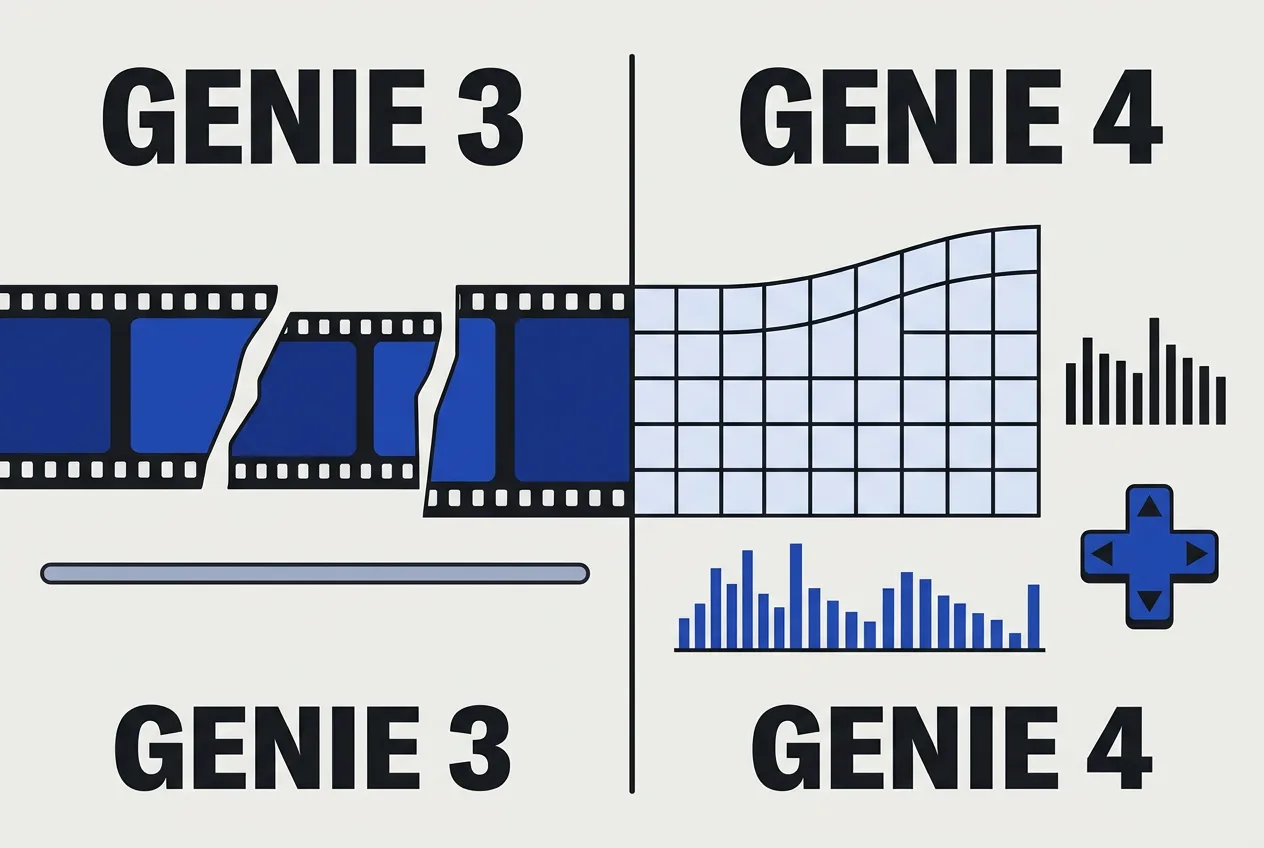
Genie 4 improves on the August 2025 research preview of Genie 3 in several measurable areas. Photorealism increased through better lighting and texture rendering. Scene consistency extended from short bursts to sustained interactions of roughly two minutes. Human character animation reduced common artifacts such as limb distortion during movement.
| Aspect | Genie 3 (2025) | Genie 4 (2026) |
|---|---|---|
| Audio | None native | Ambient, music, dialogue |
| Steering | Basic prompts | Real-time language control |
| Duration | Under 60 seconds | Up to a few minutes |
| Physics | Limited collisions | Aerodynamics and collisions |
Access began as a research preview for trusted testers on the announcement date. Expansion targets Google AI Ultra subscribers through Project Genie and early Gemini API partners. A public waitlist is open, with consumer rollout planned in phases starting at higher subscription tiers around $100 per month.
Current limitations include unspecified resolution and frame-rate details beyond Genie 3 references of 720p at 24 fps. No public API pricing or exact rollout timeline beyond “soon” has been released. Testers report occasional coherence breaks during complex multi-character scenes, typical of early generative world models.
Intended Uses and Practical Considerations
Developers use Genie 4 to prototype environments before committing resources to full game engines or 3D pipelines. Educators explore it for scenario-based training where audio feedback reinforces visual cues. Robot researchers test navigation policies inside generated spaces without physical hardware risks.
Competitors such as Runway continue to release generative environment tools, yet none currently combine native audio with the same level of prompt-driven steering. Users should verify output watermarks when repurposing generated clips for commercial projects.
Feedback from the initial tester group will shape future subscription tiers and API endpoints. No firm public timeline exists for wider availability beyond the phased rollout already described.
Frequently asked questions
How does Genie 4 generate audio?
Native multimodal audio is produced simultaneously with visuals, including ambient sounds, music, and dialogue that adapt to user-driven changes in the scene.
Who can access Genie 4 right now?
A research preview is available to trusted testers. Broader access is scheduled for Google AI Ultra subscribers and selected Gemini API partners through a phased rollout.
What improvements does Genie 4 offer over Genie 3?
Key gains include native audio, real-time natural language steering, longer scene consistency up to a few minutes, and more realistic physics and character movement.
Can Genie 4 be used for commercial projects?
Outputs include SynthID watermarks. Commercial use depends on future licensing terms that have not yet been published.
Comments 1