Google Search Console Multimodal Filter 2026: Analyzing Image and Text Search Performance
The Google Search Console multimodal filter tracks image-initiated web searches separately from text queries, enabling direct comparison of clicks, impressions and CTR.

The Google Search Console multimodal filter, rolled out on September 24 2026, splits web search performance data into image-triggered results and conventional text results. Site owners now see separate metrics for traffic that begins with Google Lens, Circle to Search, image uploads, or Chrome’s Search this image function. This separation makes it possible to measure how visual search contributes to overall visibility without mixing the two traffic sources.
How the Multimodal Filter Appears in Performance Reports
Users locate the new option inside the Search results report by selecting Search type and then choosing Web: multimodal. The same filter also works in the Generative AI report, where it records impressions only. Data becomes available only for properties that receive qualifying multimodal traffic, and the rollout remains gradual even in late October 2026.
Previously, all web traffic appeared under a single Web category. The split allows direct comparison of the same pages across identical date ranges, revealing whether certain content performs better when discovered through images rather than keywords. No query-level detail is provided because the underlying searches originate from visual input rather than typed text.
Site owners should first verify whether their properties display the new search type option. If data appears, they can export the report for further analysis outside the interface, since the Search Analytics API does not yet support the filter. Historical depth varies by property, with some records beginning around September 10 2026.
Key Limitations and Recommended Analysis Steps
The filter carries several constraints that affect how the data can be used. Queries cannot be viewed, entry points such as Lens versus image upload cannot be isolated, and API access remains unavailable. These gaps require manual export and external processing for detailed work.
- Confirm the filter is visible in both Search results and Generative AI reports.
- Export CSV files for the same pages and date ranges under each search type.
- Calculate differences in CTR and average position between multimodal and text traffic.
- Track changes over successive weeks to observe growth in visual search volume.
- Submit feedback through the Search Console help form or the Search Central Community.
Google reports that Lens alone processes billions of queries each month, yet the new filter remains the only way to isolate its contribution within GSC. Site owners who rely on visual content, product photography, or infographics benefit most from monitoring these metrics.
| Metric | Web: multimodal | Web: text |
|---|---|---|
| Available dimensions | Page, date, device, country | Page, date, device, country, query |
| Query data | Not provided | Full queries available |
| Entry point breakdown | None | Not applicable |
| API support | Export only | Full API access |
| Typical use case | Measure Lens and image-upload traffic | Standard keyword performance tracking |
Using the Data for Ongoing SEO Monitoring
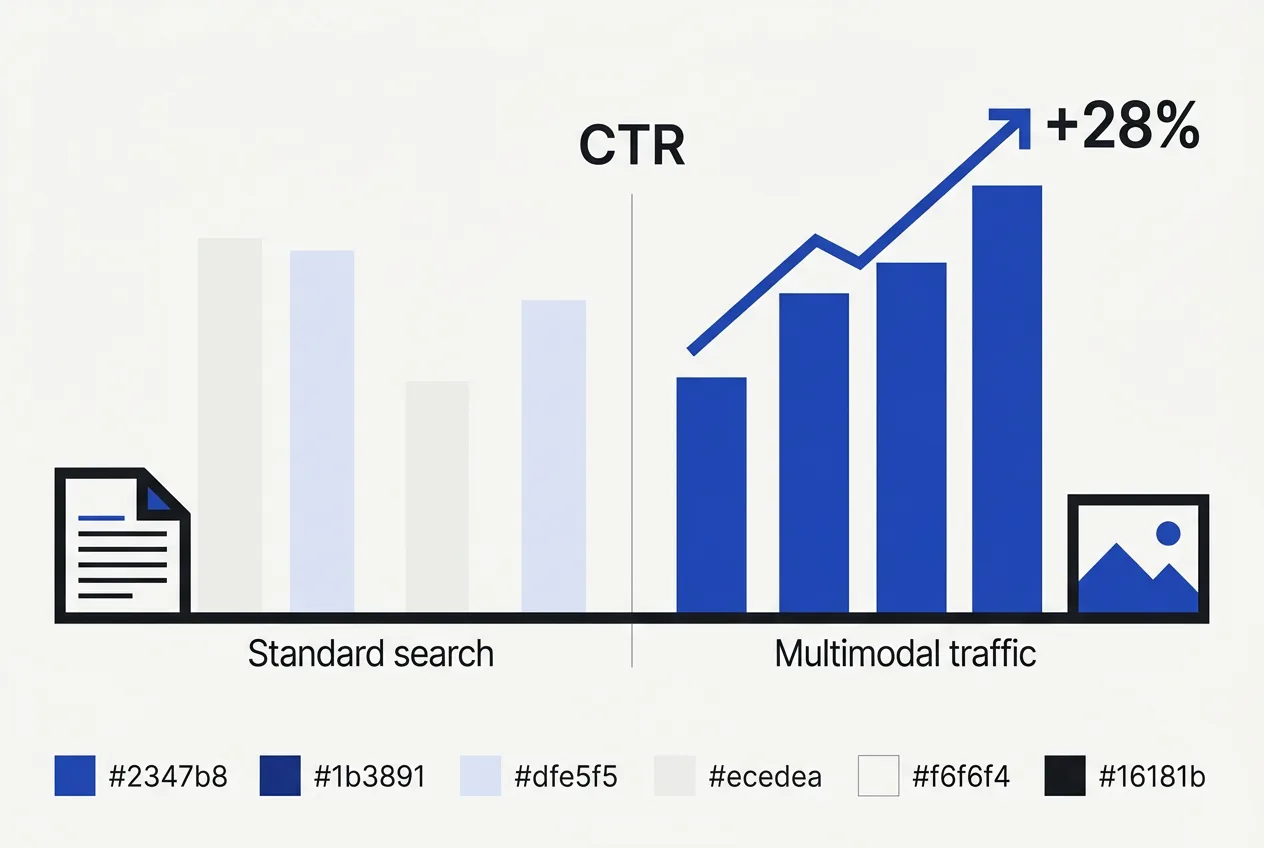
After exporting both data sets, compare impressions and clicks for identical pages to identify content that gains extra visibility through images. Pages showing higher CTR under the multimodal filter may warrant additional alt text, structured image data, or visual examples. Conversely, pages that lose position in multimodal results may need adjustments to image quality or surrounding context.
Because the filter is still new, many properties continue to accumulate data. Regular weekly exports help establish baselines before seasonal traffic shifts occur. Google has encouraged site owners to report any unexpected behavior or missing data through official channels so the feature can be refined further.
Frequently asked questions
When did Google add the multimodal filter to Search Console?
The Web: multimodal search type filter became available on September 24 2026. It separates performance data for searches started with an image from standard text queries.
Why are no queries shown for multimodal traffic?
Queries are disabled because the traffic originates from visual inputs such as Lens or image uploads rather than typed keywords. Only page, date, device and country dimensions remain.
Can I access multimodal data through the Search Analytics API?
The API does not yet support the new filter. Users must export CSV files directly from the Performance reports to analyze the data outside Search Console.
How far back does multimodal data go for a given property?
Availability varies. Some sites see data from around September 10 2026, while others receive data only after the September 24 official launch date.
Comments 1