Kimi K3.1 Pro Launch Delivers 1M Token Context and Strong Coding Results
Moonshot AI released Kimi K3.1 Pro on October 23, 2026, with a 1M token context window, MoE design and improved coding benchmarks ahead of the planned open weights release.
Kimi K3.1 Pro reached users on October 23, 2026, as Moonshot AI’s first model in the K3.1 series. It builds on the July 2026 Kimi K3 base through expanded post-training that includes joint reinforcement learning across many domains. The result is stronger performance on long-horizon coding tasks while retaining the original 1M token context window.
Kimi K3.1 Pro Architecture and Key Specifications
The model uses a Mixture-of-Experts layout with 2.8 trillion total parameters and roughly 104 billion active parameters per token. It accepts multimodal inputs including text, images and video, then produces text output. Reasoning runs continuously with three effort settings; the default is maximum effort.
Context length stays at 1,048,576 tokens. The API exposes two variants: kimi-k3.1-pro and the faster kimi-k3.1-pro-highspeed. Pricing starts at $2 per million input tokens and $10 per million output tokens, with cache reads at $0.20 per million. The high-speed option costs more but delivers two to three times the output throughput.
Enterprise features remain disabled by default. Hardware requirements mirror those of the earlier K3 model, typically needing multi-accelerator supernodes for full-scale runs. Moonshot removed cyber-related data from later training stages to prepare the model for open release.
Coding Benchmarks and Direct Comparisons
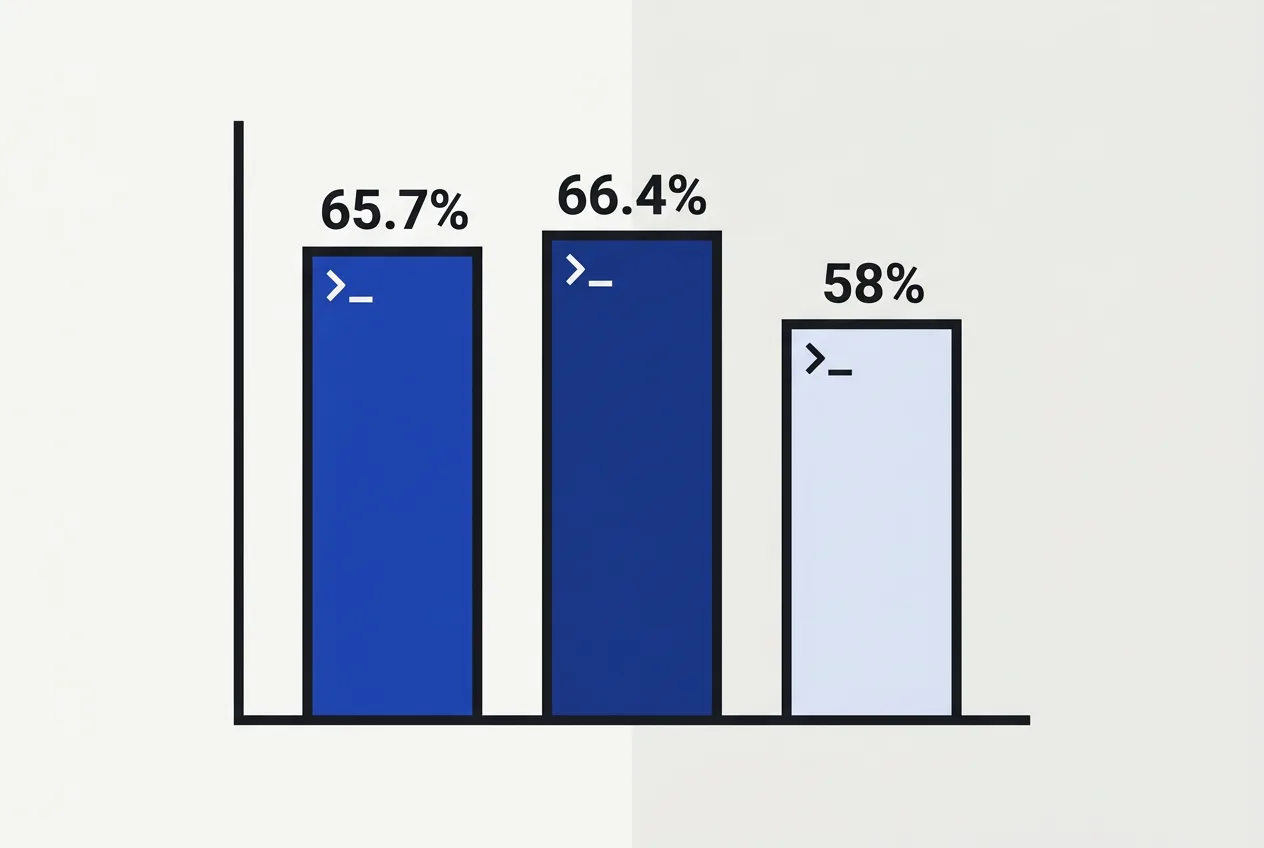
Moonshot reported results using maximum effort and the Claude Code harness where applicable. On Terminal-Bench 4.0 the model scored 65.7 percent, just behind Claude Opus 5.5 at 66.4 percent but ahead of GPT-6 Astra at 58.2 percent. Independent tests from Artificial Analysis placed it near 67.2 percent on the same benchmark.
SWE-Marathon results showed 51.7 percent, leading the published chart ahead of Claude Opus 5.5 at 46.3 percent. On the internal Kimi Code Bench 3.0 long-horizon suite the score rose to 61.2 percent from the prior K3 result of 55.95 percent.
| Benchmark | Kimi K3.1 Pro | Claude Opus 5.5 | GPT-6 Astra |
|---|---|---|---|
| Terminal-Bench 4.0 | 65.7% | 66.4% | 58.2% |
| SWE-Marathon | 51.7% | 46.3% | — |
| Kimi Code Bench 3.0 | 61.2% | — | — |
Other reported scores include 92.7 percent on BenchCAD with tools and 64.4 percent on OfficeQA Pro v2. Hallucination rate on Moonshot’s internal hard test fell to 8.3 percent from the earlier 23.4 percent. Science-related tasks remain a relative gap, with Terminal-Bench Science 0.1 at 38.1 percent.
Availability, Pricing and Open Weights Schedule
The model went live immediately on Kimi.ai/apps, Kimi Work, Kimi Code and the public API. Users can select the standard or high-speed endpoint depending on latency needs. Output speed averages around 52 tokens per second on current infrastructure.
Open weights are scheduled for November 4, 2026. Moonshot has already stripped cyber-related data from mid-training and reinforcement learning phases, lowering its internal exploit benchmark from 90.5 percent to 81.0 percent pass@3. License terms and exact file sizes will be published closer to the date.
After the release, community evaluations on platforms such as Hugging Face and independent leaderboards are expected to expand quickly. The older K2 series is scheduled for retirement by the end of December 2026. Developers planning long-context agent workflows can test the current API endpoints while waiting for the weights.
Frequently asked questions
When will Kimi K3.1 Pro weights become available?
Moonshot AI has set November 4, 2026, as the target date for open weights release. The company has already removed sensitive cyber data from training to prepare the model.
How does Kimi K3.1 Pro compare on coding benchmarks?
It leads SWE-Marathon at 51.7 percent and scores 65.7 percent on Terminal-Bench 4.0. Independent runs place it near the top of current open-weight options.
What is the context window size of Kimi K3.1 Pro?
The model supports a 1,048,576 token context window and accepts text, image and video inputs.
What are the API prices for Kimi K3.1 Pro?
Standard pricing is $2 per million input tokens and $10 per million output tokens, with cache reads at $0.20. A high-speed variant costs more but runs two to three times faster.
Comments 11