Liquid AI LFM3 Release Delivers Six Open-Weight 2B Models on Shared Backbone
Liquid AI released LFM3 on October 27, 2026, as six open-weight multimodal models around 2B parameters derived from a single 1.73B backbone.
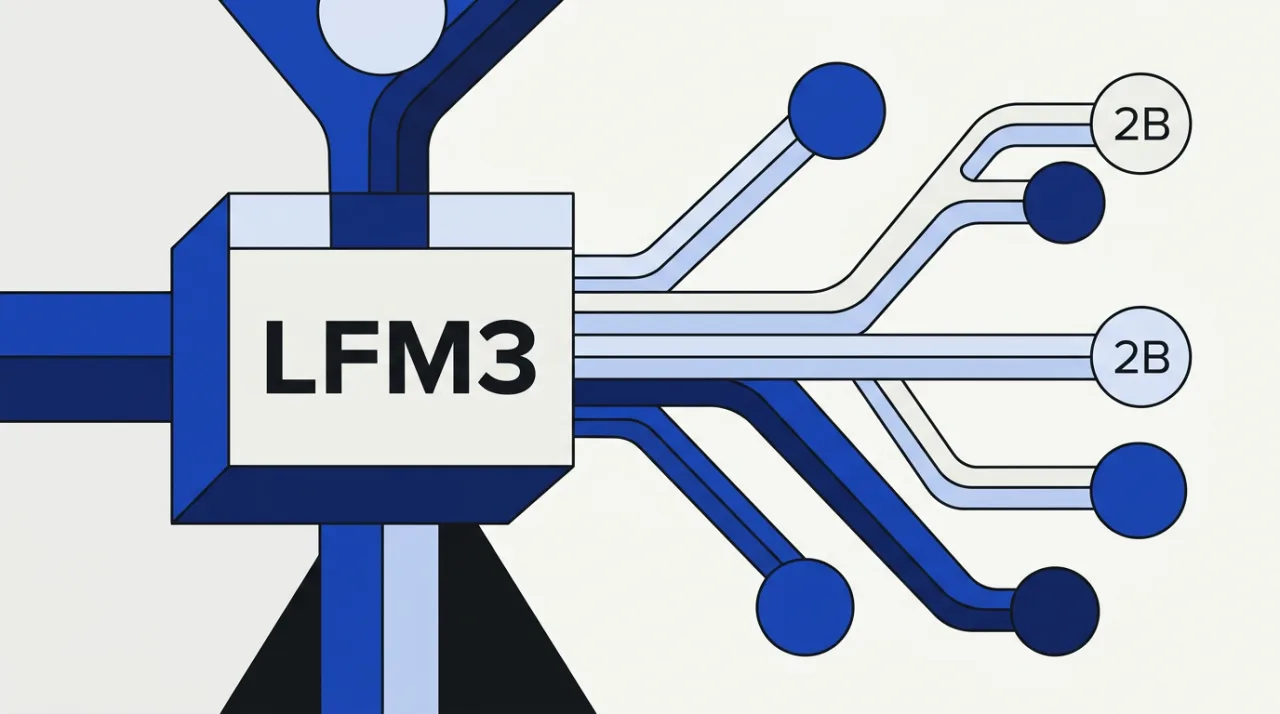
Liquid AI LFM3 appeared on October 27, 2026 as six open-weight models near 2 billion parameters. All variants descend from one 1.73 billion parameter base trained on 22 trillion tokens. The family targets on-device agents, vision, audio and structured decision tasks.
The models run at roughly 1 GB in 4-bit quantization on phones and laptops. Checkpoints ship in GGUF, MLX, ONNX, FP8 and NVFP4 formats. Partners include AMD, Arm, Intel, NVIDIA and Qualcomm.
Liquid AI LFM3 Architecture and Training Details
The shared LFM3-1.7B-Base uses a tri-hybrid design across 24 layers. Thirteen layers apply gated short convolutions with kernel size 7, five use sliding-window attention at 256 tokens, and six employ global attention. Additional features include head-wise gated attention, partial RoPE and sandwich norm. Hardware-in-the-loop search optimized the layout across 14 device and backend combinations.
Pre-training covered 22 trillion tokens with heavier emphasis on scientific papers, code, math and agentic traces than the prior LFM2 release. Mid-training added 3.5 trillion tokens focused on tool use and 256 K context extension. The text-only LFM3-1.7B reaches 256 K context while vision and omni variants use 128 K or 32 K.
Post-training produced six specialized models from the same backbone. The text model handles agents and tool calling. The vision-language variant supports video input. The audio model processes speech in 18 languages. The omni model ingests text, image, video and audio while outputting text or speech. Two decision models output calibrated probabilities and bounding boxes.
LFM3 vs Qwen3.5 Benchmarks and Practical Trade-offs
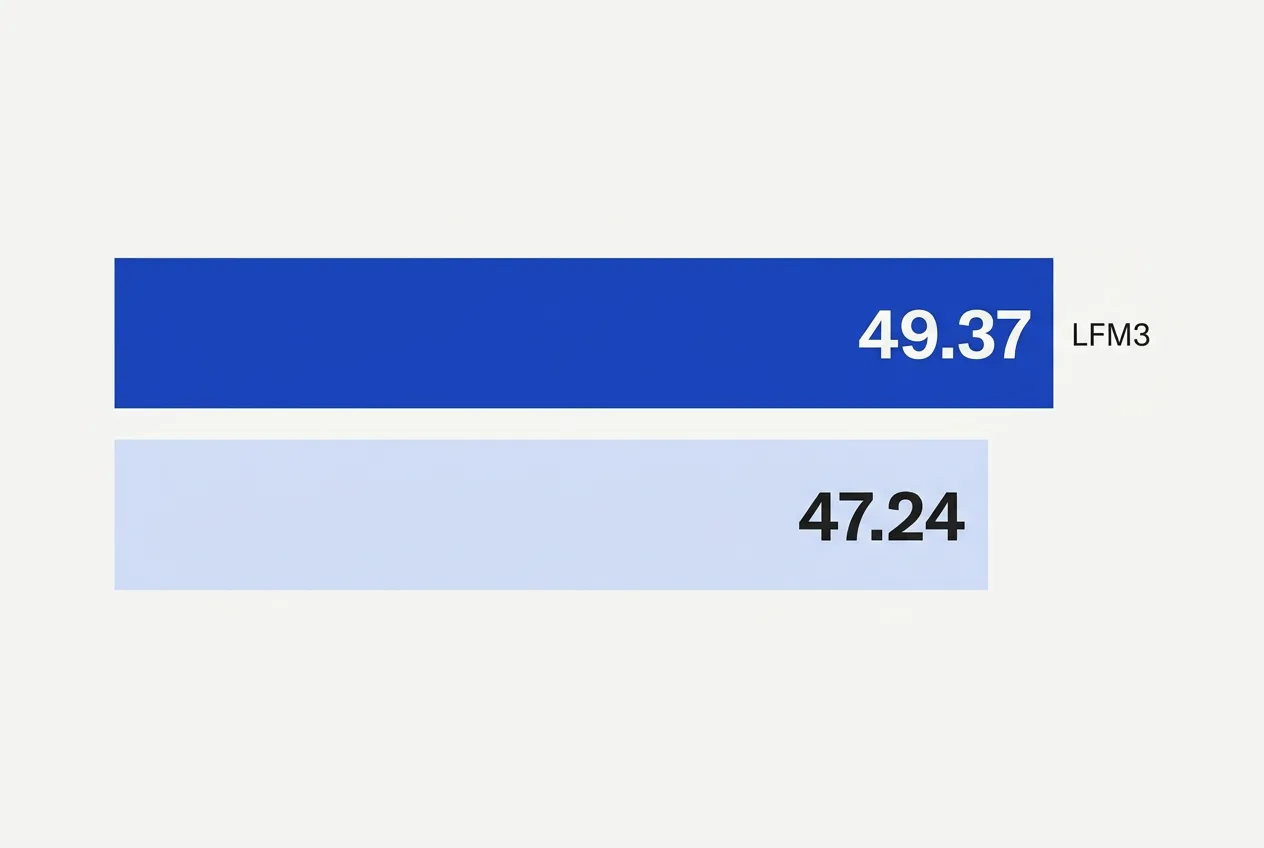
Liquid AI reported average scores on its 29-benchmark suite. LFM3-1.7B reached 49.37, ahead of Qwen3.5-9B at 47.24. Agent and instruction metrics showed larger gaps: WebArena-Verified at 38.42 versus 28.94, AutomationBench at 41.29 versus 15.10, and BFCL V4 at 71.39. The model trailed on coding and knowledge tasks such as SWE-bench Verified (43.40 versus 51.20) and GPQA Diamond (63.37 versus 80.40).
LFM3-VL-2B averaged 71.4 across 62 vision benchmarks, matching Gemma 4 12B. The series delivered a 12.7 times gain on WebArena-Verified over LFM2.5-2.6B despite 35 percent fewer parameters. On-device decoding ran 1.8 to 2.8 times faster than the next fastest tested model, with a 1.6 GB KV cache at 128 K context.
| Model | Parameters | Context | Modalities | Primary Use |
|---|---|---|---|---|
| LFM3-1.7B | 1.73 B | 256 K | Text | Agents, tool calling |
| LFM3-VL-2B | 1.92 B | 128 K | Text, vision, video | Vision-language tasks |
| LFM3-Audio-2B | 2.0 B | 32 K | Text, audio | Speech recognition and synthesis |
| LFM3-Omni-2B | 2.17 B | 32 K | Text, vision, video, audio | Multimodal input and output |
| d1-2B | 1.92 B | 128 K | Vision + structured | Calibrated decision outputs |
| d1-Omni-2B | 2.0 B | 32 K | Multimodal + structured | Multimodal decisions |
Weights sit on Hugging Face under the LiquidAI collection. The LFM Open License v1.0 permits free commercial use for companies below 10 million dollars in annual revenue. Research and non-profit use remains unrestricted. The models integrate with llama.cpp, MLX, vLLM, SGLang, Ollama and LM Studio.
Deployment Options and Licensing Limits
Fine-tuning one model fits on a single GPU. Edge deployments run comfortably at 4-bit quantization. Day-zero hardware support covers multiple mobile and server platforms. Liquid AI also provides a playground and API endpoint for immediate testing.
Users should verify benchmark relevance to their workloads, as most numbers come from Liquid AI’s own suite. Larger models still lead on broad knowledge and coding tasks. The license revenue cap means organizations above the threshold must negotiate separate terms.
Early partners tested the models in automotive vision inspection and e-commerce agent scenarios. Ongoing ecosystem work targets additional runtimes and potential larger variants.
Frequently asked questions
What sizes and modalities does Liquid AI LFM3 include?
The release contains six models near 2 billion parameters: text-only, vision-language, audio, omni, and two decision variants. All share the same 1.73 billion parameter backbone.
How does LFM3 compare to Qwen3.5-9B on agent tasks?
LFM3-1.7B scored higher on WebArena-Verified and AutomationBench while using far fewer parameters. It trailed on coding and knowledge benchmarks.
What license governs commercial use of the LFM3 weights?
The LFM Open License v1.0 allows free commercial deployment for companies under 10 million dollars in annual revenue. Larger organizations require separate agreements.
Which runtimes support the LFM3 checkpoints?
Checkpoints work with llama.cpp, MLX, vLLM, SGLang, Ollama and LM Studio. GGUF, MLX, ONNX and quantized formats are provided.
Comments 13