MAI Code 2 and MAI Code 2 Flash 2026: Pricing Context and GitHub Copilot Integration
Microsoft launched MAI Code 2 and MAI Code 2 Flash in November 2026 with specific pricing tiers and immediate availability inside GitHub Copilot across multiple IDEs.
Microsoft introduced MAI Code 2 and MAI Code 2 Flash on November 17, 2026, during its Ignite conference. The models focus on agentic coding tasks inside GitHub Copilot and target enterprise developers handling everyday maintenance and iteration work.
MAI Code 2 Pricing and GitHub Copilot Availability
Both models operate on a usage-based credit system inside GitHub Copilot where one credit equals one cent. Promotional rates apply until May 17, 2027, after which listed prices double. MAI Code 2 charges $0.50 per million input tokens and $2.50 per million output tokens during the promotion, with cached input at $0.025. MAI Code 2 Flash starts at $0.05 input and $0.25 output, with cached input at $0.005.
MAI Code 2 reaches Copilot Pro, Pro+, Max, Business, and Enterprise subscribers. MAI Code 2 Flash extends to Free and Student plans as well, often through automatic selection. Business and Enterprise administrators manage access through model policies, where new models remain enabled unless explicitly turned off. A limited preview of MAI Code 2 Flash also appears on Microsoft Foundry.
| Model | Promotional Input | Promotional Output | Post-May 2027 Input | Post-May 2027 Output | Available Plans |
|---|---|---|---|---|---|
| MAI Code 2 | $0.50 | $2.50 | $1.00 | $5.00 | Pro and higher |
| MAI Code 2 Flash | $0.05 | $0.25 | $0.10 | $0.50 | Free to Enterprise |
Access occurs through the model picker in VS Code, Visual Studio, JetBrains IDEs, Xcode, Eclipse, Copilot CLI, the cloud agent, the Copilot app, github.com, and GitHub Mobile. Microsoft positions the pricing to support high-volume routine work without requiring separate subscriptions beyond existing Copilot tiers.
Performance Benchmarks and Model Capabilities
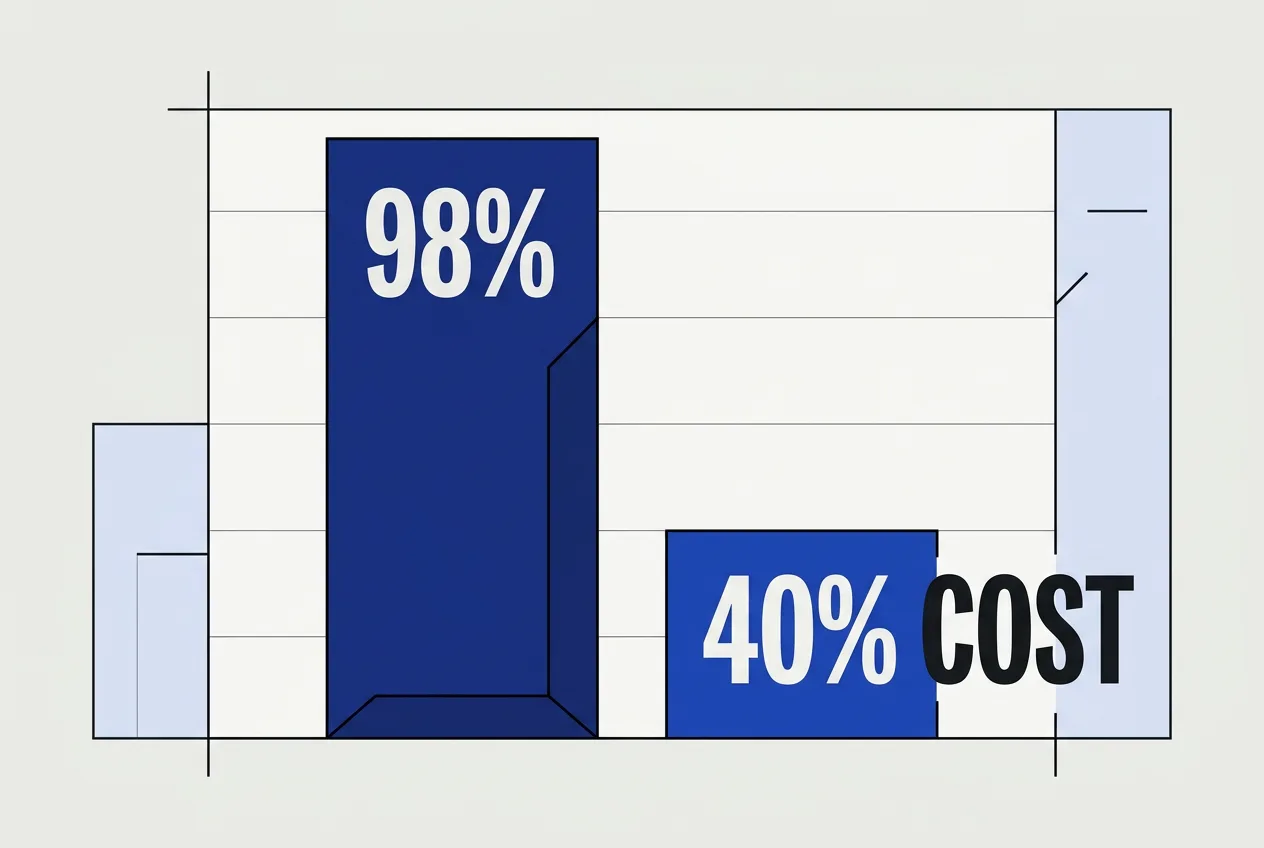
Microsoft reports MAI Code 2 reaches approximately 98 percent of GPT-6.1 Sol performance at roughly 40 percent of the cost on four coding benchmarks that include DeepSWE 1.1, Terminal Bench 2.1, SWE-Atlas, and FrontierCode v1.1. It also matches 96 percent of Claude Opus 5.5 results at about 5 percent of the cost, with average pass rates near 63.2 percent. In blind frontend evaluations involving 258 annotators, developers chose MAI Code 2 UI and visual outputs 64 percent of the time over GPT-6 Sol.
MAI Code 2 Flash delivers results comparable to GPT-6 Luna at 65 percent of the cost and Claude Haiku 5.5 at 20 percent of the cost across three high-volume benchmarks, posting an average pass rate of 61.0 percent. The model handles code explanations, targeted edits, routine fixes, and quick iterations while MAI Code 2 covers deeper debugging, multi-file refactoring, repository-wide reasoning, and production UI work. Neither model targets fundamental research or extremely long-horizon agentic tasks.
Developers can set reasoning effort from low to maximum on both models. Practical use cases include daily repository maintenance in enterprise codebases and rapid iteration on small changes in high-volume projects. Microsoft notes that all benchmark figures originate from internal testing, and independent large-scale verification remains limited shortly after launch.
Technical Specifications and Next Steps
Each model accepts text and image inputs while producing text outputs. The shared context window reaches roughly 1.05 million tokens, split as 922,000 input and 128,000 output. MAI Code 2 contains 77 to 80 billion active parameters out of 2.8 trillion total parameters. MAI Code 2 Flash contains 12 billion active parameters out of 398 billion total parameters. Both are optimized for English-language code at release, and weights remain unavailable for external distribution.
These models follow the earlier MAI Code 1 and 1.1 Flash releases from 2026. Microsoft highlights efficiency gains for routine developer workflows within its own ecosystem rather than broad scientific applications. Further rollout to platforms such as OpenRouter and Vercel appears marked as coming soon, with possible Foundry pricing updates for the Flash variant. Adoption after the May 2027 price adjustment will depend on measured task-level savings reported by users.
Frequently asked questions
Which Copilot plans include MAI Code 2?
MAI Code 2 appears on Pro, Pro+, Max, Business, and Enterprise plans. Access requires eligible annual subscriptions, and administrators can adjust availability through model policy settings.
What context window do the MAI Code 2 models support?
Both models provide a 1.05 million token context window. This breaks down to a 922,000 token input limit and a 128,000 token output limit.
How long do promotional prices last for MAI Code 2?
Promotional rates remain in effect until May 17, 2027. After that date the listed prices double for both MAI Code 2 and MAI Code 2 Flash.
Are the model weights available for download?
Microsoft has not released the weights for either model. Users access them only through GitHub Copilot and the limited Microsoft Foundry preview.
Comments 8