Mistral Large 4 open weights release brings benchmarks and licensing clarity
Mistral Large 4 open weights model delivers 1-trillion-parameter MoE performance with 1M context and modified MIT licensing for commercial use.
Mistral Large 4 open weights became available on Hugging Face on 29 October 2026 after a three-week reinforcement learning phase following the October 6 API preview. The release targets developers who need multimodal capabilities and sovereign control over model deployment. Primary advantages include a 1-million-token context window and support for over 160 languages.
Mistral Large 4 open weights architecture and features
The model contains roughly 1 trillion total parameters with 49 to 52 billion active per token. It uses a Mixture-of-Experts design with 128 experts, activating four routed experts plus one shared expert per token. The architecture includes 72 decoder layers and a 1.6-billion-parameter Pixtral-style vision encoder that accepts text and image inputs while producing text outputs.
Training occurred from scratch on 3,800 Nvidia Grace Blackwell GPUs inside Mistral’s European data centers. Three reasoning modes—low, medium, and high—allow users to balance speed against output quality, with high mode set as default. The model handles documents, charts, and engineering diagrams through native multimodal grounding.
Deployment packages released on day one include official FP8 and NVFP4 checkpoints optimized for Blackwell hardware, plus GGUF quantizations for llama.cpp. Quantized versions run on approximately four B200 or B300 GPUs, enabling self-hosting for organizations that require data residency within the EU.
Mistral Large 4 benchmarks and performance comparisons
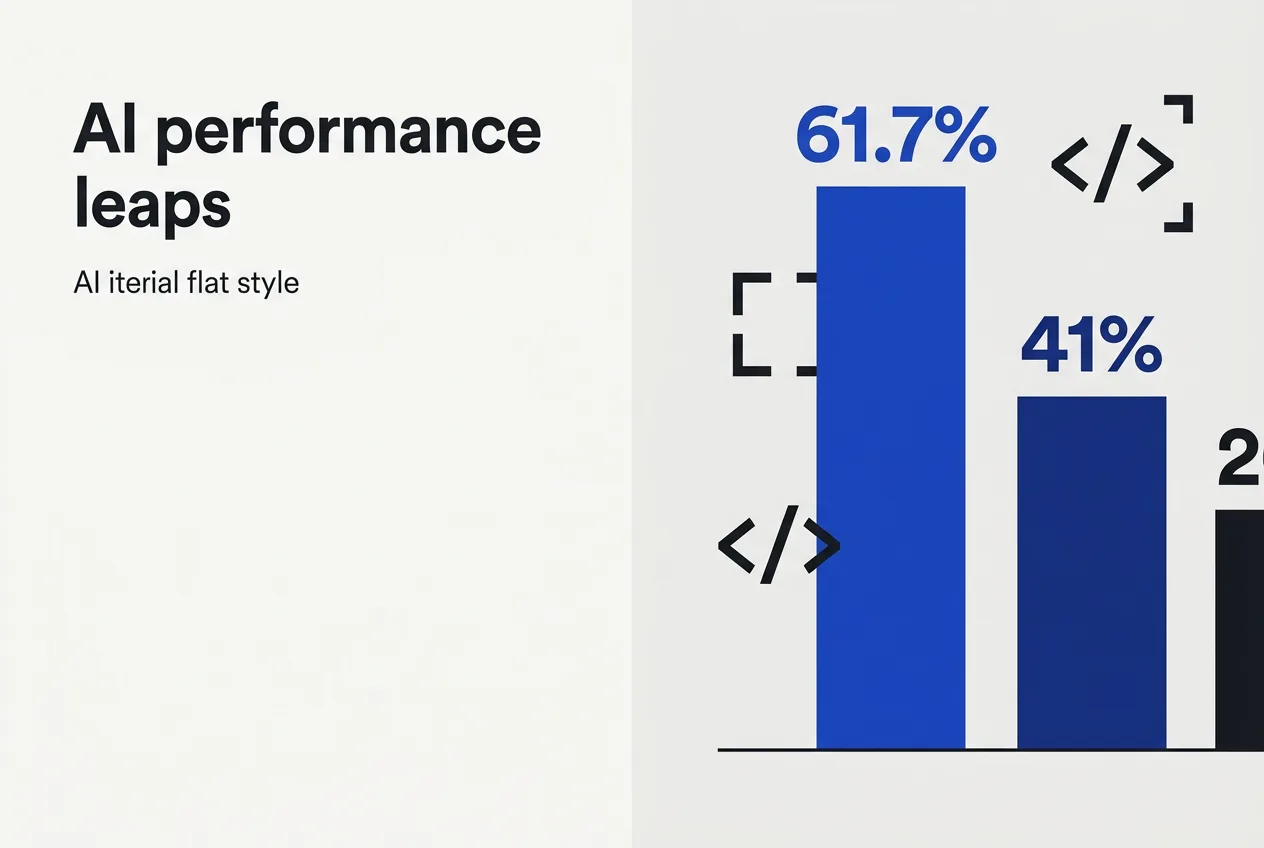
Post-release benchmarks show gains across coding, cybersecurity, and automation tasks. Terminal-Bench 4.0 rose from 28 percent in preview to 41 percent. DeepSWE v1.1 reached 61.7 percent while SWE-Atlas-QnA scored 59.4 percent. The model leads open-weight entries on the Artificial Analysis Coding Agent Index at 48 percent accuracy with fewer tokens per task than comparable systems.
| Benchmark | Score | Notes |
|---|---|---|
| Terminal-Bench 4.0 | 41% | Improved from preview |
| Artificial Analysis Cyber Index | 51% | 82% on vulnerability reproduce-and-patch |
| BrowseComp | 84.5% | Web navigation tasks |
| AutomationBench | 59.9% | Agentic workflow evaluation |
| FinWorkBench/Finch | 73.3% | Financial document analysis |
Multimodal results include 42 percent on Dense 200 visual grounding. The model ranks fifth among open-weight systems on the Artificial Analysis Intelligence Index as of late October 2026. Cybersecurity partners such as CrowdStrike and Cisco participated in red-teaming before the open release.
API pricing licensing and deployment options
Mistral Large 4 remains accessible through the company API at $0.70 per million input tokens and $2.10 per million output tokens, with cached inputs priced at $0.07 per million. The same model ID works on OpenRouter, NVIDIA endpoints, and Microsoft Foundry. Self-hosted instances avoid these fees once the weights are downloaded.
The Mistral Ecosystem Open-Weight License, derived from MIT, permits free use, modification, fine-tuning, and distribution for commercial products. Organizations that offer the model as a hosted service must obtain a separate commercial license from Mistral. Day-0 support exists in transformers, vLLM, and llama.cpp, with emphasis placed on sovereign AI use cases for finance and defensive security teams.
Frequently asked questions
What license covers Mistral Large 4 open weights?
The weights fall under the Mistral Ecosystem Open-Weight License, a modified MIT variant that allows free use, fine-tuning, and commercial distribution. Hosted model-as-a-service offerings require an additional commercial license from Mistral.
How does Mistral Large 4 compare on coding benchmarks?
It scores 48 percent on the Artificial Analysis Coding Agent Index and 41 percent on Terminal-Bench 4.0 after post-preview improvements. These figures place it among the top open-weight models while using fewer tokens per task than some competitors.
What hardware is needed to run Mistral Large 4 locally?
Quantized checkpoints run on roughly four Nvidia B200 or B300 GPUs. Full-precision inference requires data-center-class Blackwell hardware, with official FP8 and NVFP4 formats available for optimized deployment.
Does the model support image inputs?
Yes. A 1.6-billion-parameter vision encoder processes images alongside text, supporting document and chart analysis within the 1-million-token context window.
Comments
No comments yet. Be the first!