Mistral Large 4 Open Weights Release 2026: Features Benchmarks and Comparisons
Mistral released open weights for its 1T-parameter Large 4 model on October 29, 2026, under a modified MIT license with strong results on coding and defensive cybersecurity tasks.
Mistral Large 4 open weights became available on October 29, 2026, after a public preview three weeks earlier. The release gives organizations a self-hosted option for a trillion-parameter model trained in European data centers on 3,800 NVIDIA Grace Blackwell GPUs.
The model uses a mixture-of-experts design with roughly 1T total parameters and 49B–52B active parameters per token. It accepts text and image inputs through a 1.6B Pixtral-style encoder, produces text output, and supports a 1M-token context window across more than 160 languages.
Mistral Large 4 Open Weights Features and Licensing
Users can download FP8 and NVFP4 quantized checkpoints from Hugging Face under the Mistral Ecosystem Open-Weight License. This license permits free internal use, modification, fine-tuning, and commercialization, while requiring a separate commercial license for any Model-as-a-Service offering.
The API version costs $0.70 per million input tokens, $0.07 per million cached input tokens, and $2.10 per million output tokens. Day-zero support exists in transformers, vLLM, and llama.cpp, along with community GGUF quantizations. A configurable reasoning setting lets operators choose low, medium, or high effort, with high as the default.
Post-preview reinforcement learning improved coding and cybersecurity performance. The model distinguishes defensive security tasks from malicious ones and includes updated guardrails that achieve 96.6 percent average refusal on malicious cyber prompts in tested benchmarks.
Coding and Cybersecurity Benchmarks Versus Other 1T Models
Vendor-reported scores place Mistral Large 4 at 61.7 percent on DeepSWE v1.1, 59.4 percent on SWE-Atlas-QnA, and 41 percent on Terminal-Bench 4.0 after reinforcement learning. On the Artificial Analysis Coding Agent Index it reaches 48–49.8 percent while using 47 percent fewer tokens per task than GLM-5.3.
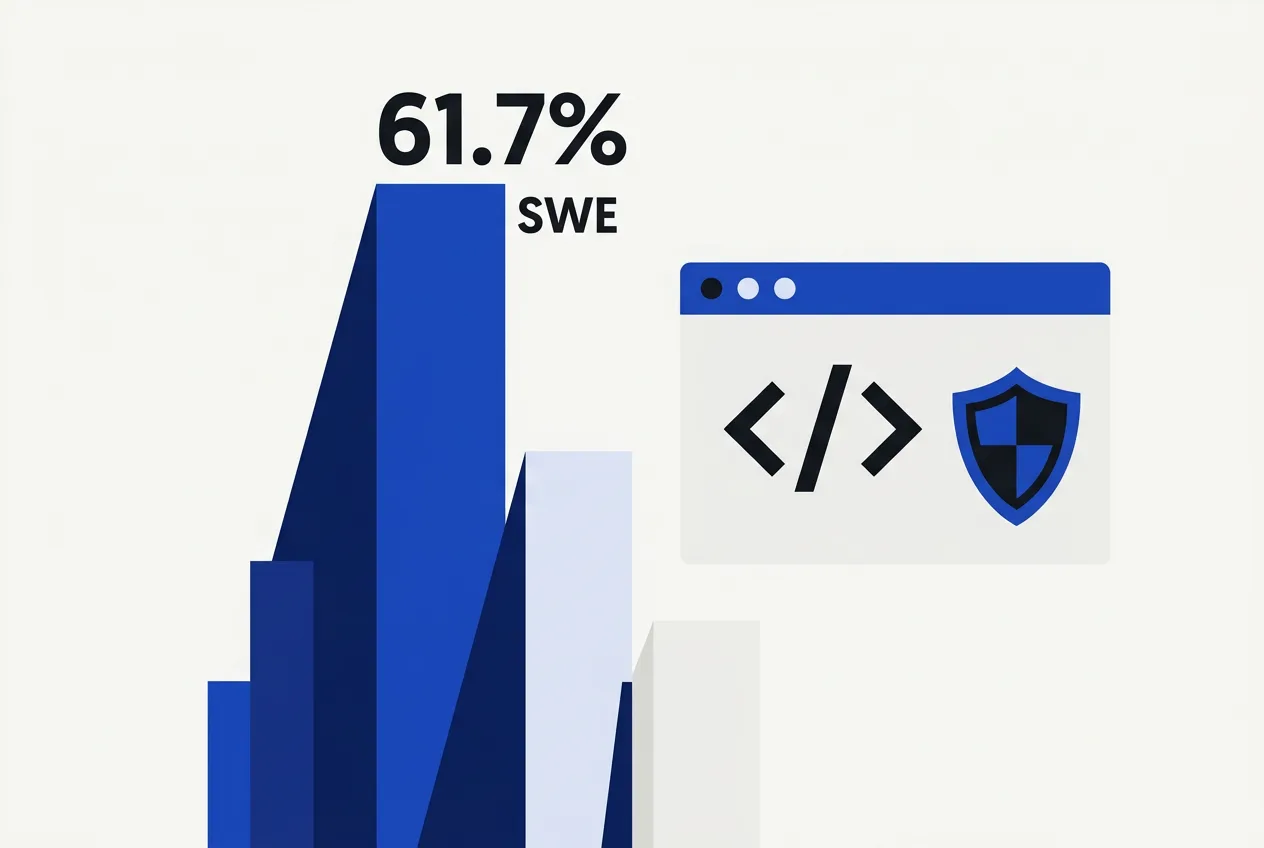
Cybersecurity results include 51 percent on the Artificial Analysis Cyber Index, 79–82 percent on CyberGym-E2E for memory-safety bug reproduction, and 93 percent on Cybench across 40 security challenges. The model leads measured open models in refusal rates on jailbreak and agent-harm datasets.
| Model | Coding Agent Index | Cyber Index | Token Efficiency | Context Window |
|---|---|---|---|---|
| Mistral Large 4 | 48–49.8% | 51% | High | 1M |
| GLM-5.3 | 47% | Lower | Lower | 128K |
| DeepSeek V4.1 Flash | Similar | Higher | Moderate | 128K |
Compared with GLM-5.3 and DeepSeek variants, Mistral Large 4 matches or exceeds them on several coding agent tasks while delivering better token efficiency. It trails the leading Chinese open models on broad intelligence and some cyber indices but offers European sovereign deployment and stronger refusal rates on offensive prompts. Closed models such as Claude Opus 5.5 still lead overall human preference rankings.
Enterprises report practical value in agentic coding workflows and vulnerability prioritization. Independent evaluations continue on platforms such as Artificial Analysis, with further guardrail updates and specialized variants expected in future releases.
Frequently asked questions
When were the Mistral Large 4 open weights released?
The weights became public on October 29, 2026, following a preview release on October 6. They are hosted on Hugging Face under a modified MIT license that allows internal commercial use.
What architecture does Mistral Large 4 use?
It is a mixture-of-experts model with approximately 1T total parameters and 49B–52B active parameters per token. The design includes 128 routed experts plus one shared expert, with four experts active per token on average.
How does Mistral Large 4 perform on coding benchmarks?
It scores 61.7 percent on DeepSWE v1.1 and 41 percent on Terminal-Bench 4.0 after post-training. It ties or leads GLM-5.3 on agent indices while consuming fewer tokens per task.
What license applies to the open weights?
The Mistral Ecosystem Open-Weight License permits free modification, fine-tuning, and internal commercialization. A separate commercial license is required for offering the model as a service to third parties.
Comments 4