P2P Crypto Exchangers 2026: Liquidity, Fee Structures and Dispute Resolution Compared
Binance P2P holds the largest share of global volume while Bybit offers the fastest tracked dispute path. Users gain practical details on spreads, KYC rules and evidence requirements before trading.
P2P crypto exchangers 2026 continue to serve as the primary on-ramp and off-ramp for users moving between local currencies and stablecoins. Binance, Bybit and OKX together account for roughly two-thirds of reported daily volume. The rest of the market remains fragmented across smaller centralized platforms and non-custodial alternatives.
Platform escrow remains the dominant model because it reduces direct counterparty risk. Non-custodial options such as Bisq and Hodl Hodl keep lower volumes and narrower fiat coverage. Traders therefore weigh liquidity depth against privacy needs when choosing a venue.
P2P Crypto Exchangers 2026 Liquidity Distribution
Daily P2P volume estimates place Binance between 215 million and 315 million dollars, representing 35 to 40 percent of tracked activity. Bybit follows with 99 million to 231 million dollars and OKX with 75 million to 122 million dollars. Combined global movement across all platforms reaches 500 million to 870 million dollars on an average day.
Binance lists 119 fiat currencies and maintains the highest number of active advertisements. Bybit supports 62 fiats while OKX reaches 110 to 111. Smaller platforms each hold under 6 percent share and show thinner order books for less common currency pairs.
| Platform | Est. 24h Volume | Fiat Count | Market Share |
|---|---|---|---|
| Binance P2P | $215–315M | 119 | 35–40% |
| Bybit P2P | $99–231M | 62 | 19–29% |
| OKX P2P | $75–122M | 110–111 | 14–16% |
| Others | Under $50M each | Varies | <6% each |
Volume figures fluctuate daily. Traders monitor live advertisement counts on aggregator sites before placing large orders to avoid wide spreads during low-activity hours.
Fee Structures and Effective Trading Costs
Most centralized P2P platforms advertise zero platform fees for standard taker and maker orders. Actual costs appear instead as seller premiums or spreads above spot prices, typically in the low single-digit percentage range. Binance applies maker fees between zero and 0.35 percent depending on the fiat market, with occasional flat taker charges on specific USDT pairs.
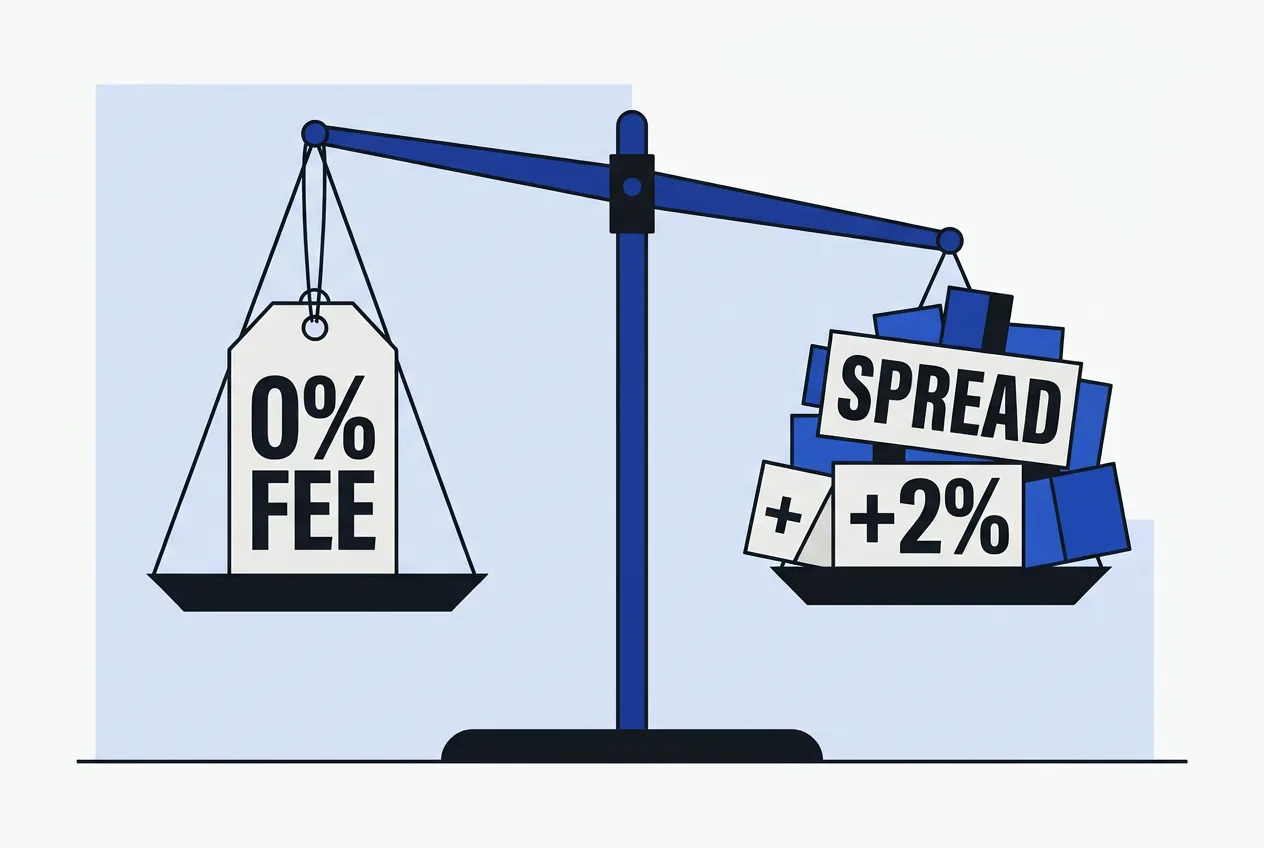
Bybit, OKX, MEXC and KuCoin generally maintain zero platform fees except in selected emerging-market currencies. Spot trading fees after P2P conversion range from zero maker and 0.05 percent taker at MEXC to roughly 0.1 percent at other venues. Withdrawal costs remain network-dependent and unchanged by the P2P layer.
Non-custodial platforms avoid platform fees entirely but often carry higher spreads due to lower competition. Users should compare live offers for their exact corridor rather than relying on headline fee rates alone.
Escrow Protection and Dispute Resolution Timelines
All major centralized P2P services lock crypto in platform escrow at order creation. Full KYC is required on these platforms; no large-volume no-KYC option exists. Non-custodial services rely on multisig or smart-contract release and do not collect KYC data.
Dispute processes differ in speed. Bybit provides a Fast-Track path that aims to resolve eligible USDT orders in about 15 minutes when the issue involves non-release or non-receipt. Its standard track exceeds 48 hours. Binance grants the counterparty a 10-minute response window before escalating to support review, though no published SLA exists.
Other platforms route appeals to customer support without fixed deadlines. Assets stay frozen until a decision is reached. All services require chat logs and payment proof; off-platform transactions fall outside coverage. Traders document every message and receipt at the moment of payment to strengthen their position in any appeal.
Frequently asked questions
Which platform shows the highest P2P volume in 2026?
Binance P2P leads with estimated daily volume between 215 million and 315 million dollars, representing 35 to 40 percent of tracked global activity.
Do P2P platforms charge trading fees?
Most advertise zero platform fees for standard orders. Real costs appear as seller premiums or spreads that vary by currency pair and time of day.
How long does a typical P2P dispute take?
Bybit Fast-Track resolves eligible cases in about 15 minutes. Other platforms require hours to several days of support review while assets remain in escrow.
Is KYC required on major P2P exchangers?
Centralized platforms require full KYC for participation. Non-custodial alternatives such as Bisq and Hodl Hodl operate without KYC but maintain lower liquidity.
Comments 13